Algemene semantiek: de wetenschappelijke methode
Hieronder een beschrijving van het proces van de wetenschap zoals gegeven door
de psycholoog Wendell Johnson, in zijn boek over de algemene semantiek getiteld
People in Quandaries
 . Johnson concentreert zich op een speciaal aspect ervan, de dynamiek, en
formuleert het in de richting van de toepassing waar het hem, en ons, om
gaat, namelijk als een manier van denken voor het hele leven, en niet alleen
voor toepassing in de wetenschap. Maar eerst een wat algemenere vorm van het
basisproces (Wendell Johnson, People in Quandaries, p. 49-50:
. Johnson concentreert zich op een speciaal aspect ervan, de dynamiek, en
formuleert het in de richting van de toepassing waar het hem, en ons, om
gaat, namelijk als een manier van denken voor het hele leven, en niet alleen
voor toepassing in de wetenschap. Maar eerst een wat algemenere vorm van het
basisproces (Wendell Johnson, People in Quandaries, p. 49-50:
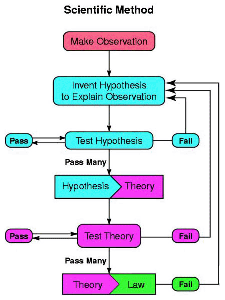 Een in de context van de wetenschap geformuleerde vorm van deze beschrijving uit
andere bron is het hiernaast staande schema. Wat daar nog eens goed tot
uitdrukking komt, is dat het hier gaat om een cirkelproces dat vele cycli
doorloopt, in de figuur aangeduid door 'Pass Many' en door Johnson als
'... a method of changing one's mind - sufficiently often.', en
dat pas na het doorlopen van die vele cycli het richting (geaccepteerde) theorie
gaat - voor een vergrote versie en een aantal soortgelijke schematische
beschrijvingen, zie
Wetenschappelijke methode Een in de context van de wetenschap geformuleerde vorm van deze beschrijving uit
andere bron is het hiernaast staande schema. Wat daar nog eens goed tot
uitdrukking komt, is dat het hier gaat om een cirkelproces dat vele cycli
doorloopt, in de figuur aangeduid door 'Pass Many' en door Johnson als
'... a method of changing one's mind - sufficiently often.', en
dat pas na het doorlopen van die vele cycli het richting (geaccepteerde) theorie
gaat - voor een vergrote versie en een aantal soortgelijke schematische
beschrijvingen, zie
Wetenschappelijke methode
 . Overigens is ook deze figuur natuurlijk een vorm van theorie, iets dat gebouwd
is op vele ervaringen, en in de praktijk ziet men vele afwijkingen en
bekortingen ervan - zie ook weer de andere figuren in Wetenschappelijke
methode
.
. Overigens is ook deze figuur natuurlijk een vorm van theorie, iets dat gebouwd
is op vele ervaringen, en in de praktijk ziet men vele afwijkingen en
bekortingen ervan - zie ook weer de andere figuren in Wetenschappelijke
methode
.
In de alinea die direct volgt op het voorgaande citaat gaat Johnson verder
in op de dynamiek van het proces, geformuleerd in de richting van de
toepassing waar het hem, en ons, om gaat, namelijk als een manier om om te
gaan met taal als de weerslag van ons denken (Wendell Johnson, People in Quandaries, p. 58-61):
Naar Alg. semantiek, inleiding  , of site home
 . .
|